

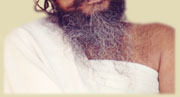





His Presence Today | PREVIOUS PAGE | NEXT PAGE
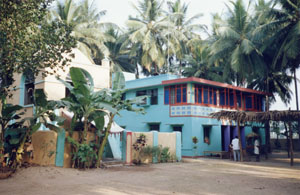
The Adivarapupeta ashram in 1994. The taller building on the left is the Dhyana Mandir. It has since been dismantled, removed, and replaced by new temple. On the right, the blue building, is where Shivabalayogi stayed and gave darshan. It, too, has been demolished to make way for the new Samadhi shrine.
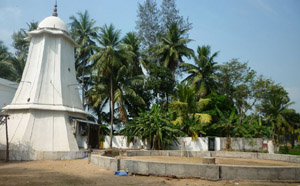
Adivarapupeta, 2010. The new Samadhi shrine and, laid out on the ground to the right, the outline of a new meditation hall.
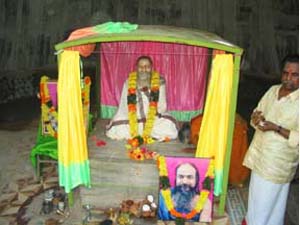
Inside the Samadhi in Adivarapupeta.
The word samadhi refers to an indescribable state of consciousness which Shivabalayogi sometimes had translated as “enlightenment”.
The word Samadhi has another meaning. It is a place where the physical presence of a yogi, avatar or great saint is anchored, typically the tomb where the physical body is buried.
Adivarapupeta, Bangalore and Dodballapur are three places where Shivabalayogi’s physical presence is anchored in a Samadhi.
The Samadhi in Adivarapupeta
Adivarapupeta is the first ashram from where Shivabalayogi’s presence radiates throughout the world.
Shri Swamiji’s sacred body is buried in the Samadhi in Adivarapupeta, the ashram on the site of where he sat for almost all of his twelve year tapas. The Samadhi is in the same place where he used to give public darshan.
The original ashram building was small and its foundation weak, so the Adivarapupeta trustees commissioned plans for a new structure consisting of two parts, an inner Samadhi building over Swamiji’s tomb, and a large hall in front. The inner Samadhi building was inaugurated on March 6, 2008.
A large hall will be constructed in front of the Samadhi, to its north, large enough to accommodate devotees gathered for bhajans, meditation, and various functions celebrated at the ashram. Like the Samadhi itself, this large hall will have a circular building footprint.
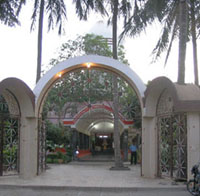
The main entrance to the Samadhi at the ashram in J. P. Nagar, Bangalore.
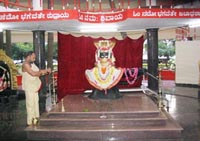
Inside the Samadhi in Bangalore.
The Samadhi in Bangalore
The Bangalore Samadhi was consecrated on April 10, 1994, according to Shivabalayogi’s wishes. It is in the center of the four-acre site where Shivabalayogi had planted a circle of rudraksha trees, trees sacred to Lord Shiva.
A pit was dug and carefully lined with stone, then a bed of blessed vibhuti (ash). After a homa fire ceremony and its final offerings made (purnahuti), a small portion of his matted hair (jata), the cloth he was wearing in Adivarapupeta just before he entered mahasamadhi, a Shivalinga made from the earth in which his holy body was buried, and some personal effects were placed inside.
That same night, heavy rain fell on Bangalore, an auspicious reminder of the presence of a great yogi.
Granite slabs and a large Shivalinga have been installed over the Bangalore Samadhi and an open, temple-like structure has been built so that the rudraksha trees that are sacred to Shiva and which Shri Swamiji wanted planted would not be disturbed.
The Samadhi in Dodballapur
At the same time the Samadhi was consecrated at the Bangalore ashram, a Samadhi was consecrated at Shri Swamiji’s ashram in Dodballapur, a small town less than fifty kilometers north of Bangalore.
Dodballapur was the second ashram dedicated to Swamiji. As at the main Bangalore ashram, the Samadhi at Dodballapur contains a small piece of Swamiji’s hair, blessed vibhuti, a shawl that Swamiji used to wear, and some other personal effects.
The Samadhi of Parvatamma Allaka
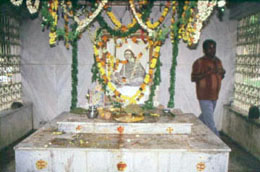
The Samadhi where Shri Swamiji’s mother, Parvatamma Allaka, is buried at the
original Bangalore ashram on Bannerghatta Road,
near the main ashram in J.P. Nagar.
Swamiji’s mother, Parvatamma Allaka, was God-realized in her own right. She had the vision of the rimurthy (the three forms of God: Brahma, Vishnua and Shiva) shortly after Swamiji was made to sit in tapas.
When she passed away on June 15, 1976, Shivabalayogi consecrated a Samadhi to her at the original Bangalore ashram on Bannerghatta Road. Swamiji visited his mother’s Samadhi often, particularly before leaving or returning from a journey away from Bangalore.
Each August 15 is set aside as a special function to honor Parvatamma. There is a homa, mass feeding and bhajans at the Bannerghatta Road ashram, and Shivabalayogi never fails to attend.
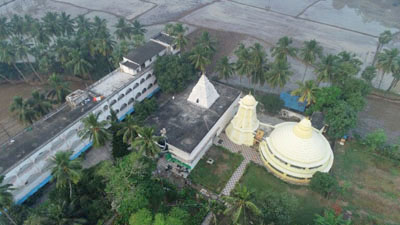
Adivarapupeta ashram.
The Sacred Presence
Those who did not have the opportunity to have darshan of Shivabalayogi in his own physical body, and those devotees who did, can experience the same physical presence at his Samadhi.
The experiences are many. This one is a sample:
“I was sitting in meditation next to the Samadhi in the middle of the Bangalore ashram garden. Although my eyes were closed, I saw Swamiji come up to me from the left and I felt Swamiji touch my left ear. I got up from my meditation, then shortly resumed it. This time I saw Swamiji come up from my right side and, like before, I could very definitely feel his touch, this time on my right ear.”